 français
 English
 Deutsch
 italiano
 español
 português
 Nederlands
 Türkçe
 Tiếng việt
 Indonesia
 svenska
 norsk språk

Send the same artwork to five Chinese umbrella factories and you will get five different unit prices. That is not because four of them are lying. It is because "a custom umbrella" is not one product. It is a stack of decisions — canopy fabric, rib count, frame material, shaft type, handle, printing method, print coverage, packaging and order quantity — and each decision moves the number.
This guide breaks a custom umbrella price into its parts, so you can see which line items you are actually paying for, which ones you can trade away, and which ones you should never cut. It is written for B2B buyers placing custom umbrella orders for retail programmes, corporate gifts, hospitality or promotional campaigns.
One thing to get out of the way first: there is no universal price list. Any supplier who quotes you a fixed number without your artwork, quantity and destination is guessing. What you can compare is structure — and that is what follows.
Every umbrella quotation, from a 100-piece corporate order to a 50,000-piece retail programme, is built from the same six blocks. Understand them and you can read a quote like a spec sheet.
Fabric is priced per metre, and the canopy consumes several metres per unit. The variables are the yarn and the finish: 190T pongee, 210T pongee, polyester, impact cloth, transparent POE, recycled RPET. Higher thread count means a denser, smoother surface that prints better and sheds water faster. Coatings (PU, PA, Teflon-style water repellent, silver or blackout UV coating) add cost but change how the umbrella behaves in real rain.
Rib count and rib material are the two biggest structural cost levers. An 8-rib steel frame is the cheapest thing that works. A 16-rib frame uses twice the ribs, twice the joints and more assembly time. Fibreglass ribs cost more than steel but do not bend permanently in gusts, which is why windproof models use them. Full fibreglass frames and shafts cost more again.
A three-fold aluminium shaft, a straight steel shaft, a fibreglass shaft and a carbon fibre shaft sit at very different points on the cost curve. Handles follow the same logic: moulded plastic, EVA foam, rubberised ABS, bamboo, and solid wood with a curved hook. Wooden handles are usually hand-fitted, so labour enters the price, not just material.
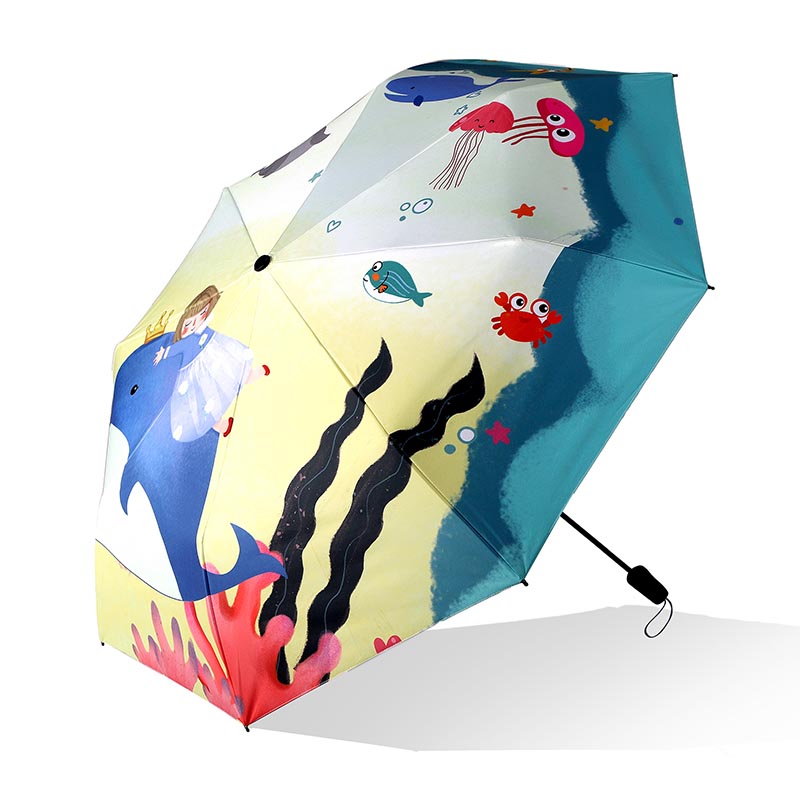
Print coverage, not just colour count, is what separates a cheap print from an expensive one.
Printing is where quotes diverge most, because the same logo can be produced four ways. Screen printing charges per colour per screen; heat transfer charges for the transfer film and the mould; digital printing charges for machine time and ink; dye sublimation charges for the transfer paper and requires the fabric to be printable. Print coverage matters as much as method: one panel with a logo costs far less than a full-canopy design running across eight panels.
| Cost block | What moves it | Your lever as a buyer |
|---|---|---|
| Canopy fabric | Thread count, coating, recycled content | Choose the fabric for the climate and the price tier, not the catalogue photo |
| Ribs & frame | Rib count, steel vs fibreglass, full-fibre frame | Match rib count to the wind load of the market you sell into |
| Shaft & handle | Material, folding stages, hand-fitted wood | Upgrade the handle only where the buyer touches it |
| Printing | Method, colour count, panels covered, setup | Reduce colours before reducing quality |
| Packaging | Polybag, colour box, insert card, retail carton | Decide retail-ready or bulk-packed before you ask for a quote |
| Labour & QC | Assembly steps, inspection standard, custom labelling | Do not negotiate this line down; it is the one that protects your returns rate |
A polybagged umbrella and a colour-boxed umbrella with a barcode sticker are two different products at the warehouse. If you sell on Amazon or into retail chains, packaging is not decoration — it is compliance. Carton configuration also affects freight, so the cheapest unit price can produce the most expensive landed cost.
Umbrella assembly is still largely manual: cutting, sewing the canopy, tipping the ribs, fitting the runner and spring, attaching the handle. A factory that inspects every unit and open-closes it before packing spends more minutes per piece than one that ships straight from the line. That difference shows up as a line item, and it is usually worth paying.
Quantity affects price through three separate mechanisms, and buyers usually only think about the first.
Most Chinese umbrella factories, including ours, work from a minimum order of 100 pieces per design. Below that, the setup cost dominates and the unit price stops being meaningful. If you need fewer than 100, the realistic options are stock colours with a single-colour print, or buying a small run and accepting a higher per-unit cost.
Quotes are usually built on a clear specification. These are the items that arrive later and change the invoice:
Over-speccing the frame. A 16-rib fibreglass frame is the right answer for a golf club or a windy coastal city. For an indoor hotel lobby umbrella or a trade-show giveaway, it is money spent on a feature nobody will test.
Too many print colours on a low price point. Four-colour process printing on a promotional umbrella at a two-colour budget is the most common mismatch we see. Either accept fewer colours or move up a price tier.
Splitting a small order into many SKUs. Ten colours of a 500-piece order is ten short runs. Consolidating to three colours usually buys a better fabric at the same total spend.
Ignoring the landed cost. Carton size and weight determine freight. A slightly lighter umbrella with a more efficient carton can beat a cheaper unit price once it is on a ship.
Put both quotes against the same eleven lines and the difference usually explains itself:
If a supplier cannot answer all eleven, the quote is not comparable — it is a number. For reference, here is how a real specification reads on our own 54 inch double layer vented canopy golf umbrella: 30 inch by 8-rib stick frame, auto open, full fibreglass frame and shaft, 190T black solid pongee canopy, two-layer vented construction, black EVA handle, minimum order 100 pieces. Every one of those clauses is a cost decision you can accept or change.
Sampling is the cheapest part of the project and the most expensive part to skip. A pre-production sample confirms five things at once: fabric hand feel and colour under daylight, print registration on a curved panel, rib tension, handle fit, and whether the open-close action feels like the price you are paying. Expect a sample charge, and expect it to be credited against the bulk order in most factories.
Two practical rules. First, approve a sample against the same Pantone references you will put in the purchase order — not against a screen. Second, keep the signed sample; it is the only objective reference if a bulk delivery is disputed.
We will not publish a price table here, and you should be sceptical of any factory that does. A unit price without fabric, frame, print method, quantity, packaging and destination is a marketing number. What we can do is quote against a fixed specification within one working day, and show you what changes when you move one variable at a time — which is the only way to know whether an upgrade is worth its cost.
For our range it is 100 pieces per design. That threshold exists because screen and transfer setup costs are fixed; below 100 pieces the setup dominates the unit price and the economics stop working for both sides.
Not automatically. 190T pongee is a proven, water-resistant workhorse for promotional and hospitality umbrellas. Going to 210T or adding a coating improves print smoothness and water repellency, but if the umbrella will be used a few dozen times a year, that money is better spent on the frame.
Usually one of three reasons: the fabric or handle has changed price, the second order is smaller or split across more colours, or the first quote excluded packaging or freight. Ask for the quote broken down by block rather than as a single figure.
Yes, and it is common for corporate programmes. Each colourway is produced as its own run, so the per-unit price is set by the smallest run in the order, not the total. Consolidating colours is the fastest way to improve a mixed order's price.
Yes, because a one-off sample consumes the same setup as a production run. Most factories, including ours, credit the sample fee against the bulk order once it is placed.
It depends on the print method, the fabric (stock versus dyed) and the season. The honest answer is that lead time is quoted per project after the specification is fixed, and it should be written into the purchase order with the shipping method.
If you already have artwork and a quantity, send both and we will come back with a specification-level quote rather than a range. If you are still deciding, tell us the market, the budget per unit and where the umbrella will be used, and we will tell you which line items to spend on and which to cut. You can send your specification to our team here.


Adresse : Huli High-tech Park, Huli District, Xiamen, Fujian, China
Continuez à lire, restez informé, abonnez-vous et nous vous invitons à nous dire ce que vous en pensez.
Droits d\'auteur © Susinoumbrella.com - DYY LIMITED Tous droits réservés.
Plan du site
| Blog
| Xml
| politique de confidentialité
 Réseau pris en charge
